
— MEET YOUR COACH
Elizabeth Banks.
Twenty years of deep specialisation.
Founder of The Movement Bank™. Advanced-level P-DTR practitioner, one of a small number in the UK. Practising at the intersection of neuroscience, biomechanics, and movement coaching for two decades. Based in Liverpool Street, London.
— MY STORY
The injury that started
a lifelong pursuit.
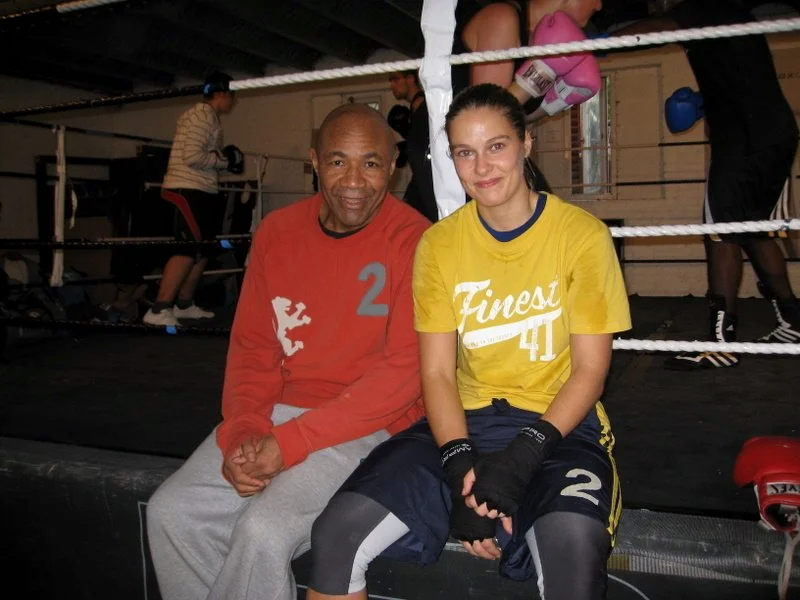
Ringside, early days with a mentor who changed everything
I have always loved sport and training. Athletics, hockey and football as a young athlete, and boxing at university, where I finally had the chance to act on that love by setting up the club with two friends who became my sparring partners. As a female, that in itself was not without its challenges.
The pursuit to excel brought challenges to my body. I experienced debilitating injuries and know first-hand the pain and angst of being unable to do the things you love. That frustration is not abstract to me. It is personal.
My personal experience ignited a mission within me: to find a way back to freedom and confidence in movement. I worked through multiple therapists and treatments. Progress was slow, and I was consistently told to give up boxing.
Then fate intervened. I met one of my mentors, a practitioner who eliminated my boxing-related pain within minutes, without touching the site of my injury. The joy and tears that followed as I threw punches without hesitation or pain for the first time in years changed the course of my life. I had to understand how that was possible.
I have reconciled that this is a lifelong pursuit. The more I learn, the more I realise how much there still is to comprehend. What I have come to know, through twenty years of study and practice, is that the body is remarkable at healing when given the right environment and the right inputs.
My role is to identify which inputs are missing or miscalibrated, and to give the nervous system what it needs to do the rest. I am a facilitator in the process, not the source of it.
I have been privileged to work with a wide range of clients through the years, first in fitness, where I became the go-to trainer for focused training that got long-term results without breaking down bodies, and later in clinical settings alongside exceptional practitioners helping people return to the things they love.
The Movement Bank™ was born from all of it. A private studio designed to show you that there is a different path, one that prioritises your wellbeing and guides you toward pain-free, confident movement.
Elizabeth Banks
FOUNDER & COACH, THE MOVEMENT BANK™
— WHERE THIS WORK SITS
How this works with physiotherapy
It is the question I am asked most often, so it is worth answering plainly.
Movement coaching, as I practise it, is a specialised and distinct field. It is not physiotherapy, and it is not trying to be. Physiotherapy is a regulated medical profession that diagnoses injury, treats tissue, and rehabilitates the structural consequences of injury and surgery. It is essential work, and I have deep respect for it. I hold my own professional standards, insurance and advanced certification in the methods I practise, and I work to those rigorously.
What I do is different work, not later work. Some clients come to me having completed a course of physiotherapy. Others are working with a physiotherapist at the same time as seeing me, and the two run in parallel rather than in sequence. There is genuine overlap between us, and where a client already has a physiotherapist I am glad to work in conjunction with them. Often the best outcome comes from a team, each person doing the part they are trained for.
My part is the nervous system. When an injury has been diagnosed and treated and the tissue has healed, but movement still does not feel right, the question becomes a different one. Why is the nervous system still treating safe movement as a threat? That is what I assess, and that is what I work with.
This means I do not issue formal medical diagnoses, prescribe, or treat acute injury. What I do instead is take the diagnosis, the scans and the findings you already have, and use that information as the starting point for the work. Within P-DTR, I do diagnose dysfunctional sensory receptors. That is the method's core skill, but it is a different kind of diagnosis to the one a doctor or physiotherapist performs.
— THE APPROACH
Inside-out, not outside-in.
With a degree in Sport Science as her foundation, Elizabeth completed both immersive mentorships at the Gray Institute in the USA, enriching her understanding of movement and its impact on the human body.
Building on that biomechanical foundation, she immersed herself in functional movement neurology with Z-Health, AMN, and P-DTR, achieving advanced-level certification in each, a testament to her dedication to mastering specialised techniques.
The result is a practice that addresses the root cause of dysfunction rather than its symptoms, working at the level of the nervous system to produce changes that hold.
— FORMAL TRAINING
Qualifications built over two decades.
Elizabeth's training spans the institutions shaping modern movement science and neurology. Each qualification represents hundreds of hours of study, supervised practice, and clinical application, pursued across the UK, Europe, and the United States.
The breadth reflects the method. No single framework explains human movement completely. Elizabeth draws from applied functional science, movement neurology, proprioceptive therapy, and foot biomechanics to build a genuinely integrated approach.
EDUCATION CREDITS
Elizabeth has delivered international education programmes for TRX, Nike, Applied Movement Neurology, and Procedos.
* Based on client-reported outcomes across two decades of private practice.
— EDUCATION AND TRAINING
The key institutions behind the method.
These are the education bodies Elizabeth has personally trained with and continues to pursue further education through.
FOUNDATION
St Mary's University, London
Sport Science · BSc (Hons)
The academic foundation that underpins everything that followed. A degree in Sport and Exercise Science from St Mary's University, London, one of the UK's leading sports universities, provided the evidence-based grounding in human physiology, biomechanics, and exercise science from which all subsequent specialist training has been built. stmarys.ac.uk →
BIOMECHANICS
Gray Institute
GIFT, PCM, CAFS, 3DMAPS, NG360 · USA
The Gray Institute was my transformative gateway into understanding human movement at a profound level. It required a significant commitment in every aspect of my life, and it proved to be a life-changing experience.
As the epitome of functional human movement education, the Gray Institute stands at the forefront of the field. I have proudly completed both 10-month long mentorship programmes, GIFT (Gray Institute for Functional Transformation) and PCM (Play Coach Mate), in the United States.
Additionally, I have pursued further professional development through continuing education with CAFS, 3DMAPS (Three Dimensional Movement Analysis and Performance System), and NG360 (Nike Golf 360). grayinstitute.com →
NEUROLOGY
Z-Health
Movement Neurology · R Phase, I Phase, S Phase, T Phase & 9S Certifications
Z-Health served as my initial exploration into the world of movement neurology, marking a pivotal moment in my professional journey. It was a profound deep dive that spanned several years of dedicated education, and my learning with Z-Health continues to this day.
Under the guidance of Dr Cobb and the esteemed Z-Health faculty, I have honed my skills in working with more complex conditions and have achieved lasting and profound results for the individuals I work with. Their expertise and teachings have been instrumental in my ongoing development as a practitioner. zhealtheducation.com →
NEUROLOGY
AMN · Applied Movement Neurology
Dave Fleming and Luke Sherrell
Further exploration of movement neurology led me to AMN, where I had the privilege of working and training directly with Dave Fleming and Luke Sherrell. AMN is a methodology that places a strong emphasis on brain-based corrective exercise, with a particular focus on gymnastics.
AMN techniques look to calibrate faulty electrical charges within the body's various systems, promoting improved movement patterns and enhanced nervous system function. amnacademy.com →
BIOMECHANICS
Foot Mobilisation Techniques
All levels · Ted Jedynak
I had a strong focus on foot function along my biomechanics journey, realising its importance as the foundation of human support. It amazed me how little attention we gave to this vital aspect.
This led me to Foot Mobilisation Techniques taught by podiatrist Ted Jedynak. Learning all three levels of FMT directly from Ted has been instrumental in expanding my knowledge and application with clients, offering valuable insights and strategies to improve foot function and enhance overall body performance. footmobilisation.com →
PERFORMANCE
Weck Method & RopeFlow
David Weck and Chris Chamberlain
Having the opportunity to learn directly from David Weck himself was one I could not miss. The Weck Method is an innovative approach centred on the "coiling core", a concept inspired by spinal engine theory that David has uniquely applied and expanded through his RopeFlow system and comprehensive education.
It has helped me deepen my understanding of rotational power, movement efficiency, strength, and neuromuscular coordination. The training was delivered alongside Chris Chamberlain, known for his exceptional programming concepts and overarching approach to "eroding weakness." The experience refined my practice in a way that felt both natural and transformative.
I also use RopeFlow, a dynamic, rhythmic training system that promotes fluidity, coordination, and the seamless integration of rotational movement into all movement patterns. This fits perfectly with my philosophy of building your Movement Bank™. weckmethod.com →
BIOMECHANICS
Anatomy in Motion (AiM)
Gary Ward
Anatomy in Motion, led by Gary Ward and his team, simplifies complex concepts and provides practical strategies for immediate application. Their emphasis on understanding the whole system, particularly foot function's impact on movement, has been invaluable in refining my education and enhancing my practice. findingcentre.co.uk →
MOVEMENT
MovNat
Natural Movement
MovNat allowed me to add structure to what I was naturally drawn to from a movement perspective. It provided a framework that aligned with my innate inclination towards natural movement, emphasising movement quality, functional strength, and adaptability.
MovNat's focus on restoring vitality and exploring the full spectrum of human capabilities resonated deeply, adding a natural progression and variation to my training, unlocking new levels of physical freedom and potential. movnat.com →
NEUROLOGY
P-DTR · Proprioceptive Deep Tendon Reflex
Advanced certification · Dr Jose Palomar
Developed by Dr Jose Palomar, a renowned neurologist and researcher. It draws on principles from neurology, biomechanics, neurophysiology, anatomy and extensive research to work directly with the central nervous system. P-DTR uses a comprehensive assessment process to identify and correct imbalances in the nervous system, which can lead to dysfunction and pain.
One of the unique aspects of P-DTR is its focus on the role of sensory nerve endings, or "receptors," in the function and processes of the central nervous system. By working with these receptors, P-DTR can be used to understand, assess and treat all kinds of dysfunction, pain and symptoms that it is possible to experience in the human form.
To illustrate the scope within which P-DTR is capable of operating, we can compare it to a computer system, where hardware, software and firmware work together. In the human body, the hardware is the bones, ligaments, organs, nerves, and blood vessels, while the software is the communication within the CNS and its many interconnected functions. The firmware includes primitive reflexes and some of the autonomic unconscious functions that our bodies perform.
As a therapy, P-DTR can be used primarily to treat the software and firmware components of the above analogy, however it also has an important role in treating the causes of some hardware problems such as chronic degenerative conditions or post-operative changes to the body's structure. p-dtr.org→
NEUROLOGY
Next Level Neuro
Kathy Mauck and Matt Bush
Next Level Neuro provides world-class education and support for incorporating neurology into individual sessions and business practices. Their expertise and guidance have been instrumental in my journey, supporting my professional growth and helping me integrate neurological principles more deeply into every session. nextlevelneuro.com →
COACHING
Enneagram Integrative Coaching
Certified Enneagram Practitioner
Alongside my certifications in movement and neurology, I am also a certified Enneagram practitioner. The Enneagram is a powerful framework that goes far beyond a personality profile, it offers a deep and transformative roadmap to self-awareness, helping you understand the unique lens through which you experience the world.
This lens shapes everything: how you experience pain, your relationship to risk and reward, and the unconscious drivers behind your behaviours. For those facing challenges beyond the physical, I offer standalone coaching sessions focused on shifting mindset, behaviour, communication, and emotional resilience.
NEUROLOGY
RHM · Recursive Human Mechanics
David Fleming
RHM marked a meaningful expansion of my practice, moving beyond the purely physical layer of pain and movement into the deeper architecture of how the body organises itself under constraint. Being part of the first cohort trained by David Fleming has been one of the most significant chapters in my professional development, and a natural progression of where my work was already heading.
Underpinned by Recursive Field Theory, RHM is a structural framework that recognises chronic symptoms, whether physical, neurological, or systemic, not as random malfunctions but as coherent, stabilised adaptations. The body organises around constraint. It protects, predicts, and preserves. When those patterns persist beyond their original purpose, they become the thing that needs addressing. Not just the symptom they produce.
RHM has given me a precise way to work with clients whose pain, restriction, or dysfunction has not resolved through physical intervention alone: understanding why the pattern exists, what is maintaining it, and what needs to shift for genuine reorganisation to occur. Biology and psychology are not separate layers in this model. They are recursively interconnected, and lasting change requires working with that reality rather than around it. thedavidfleming.com →
— THE NETWORK
How clients reach me.
Much of the practice now arrives through professional referral. The rest come by word of mouth, or by looking for a different angle on a long-standing question.
THROUGH REFERRAL
From practitioners I work alongside
Physiotherapists, osteopaths, GPs, sports medicine doctors and specialist consultants refer clients whose cases call for a neurology-first lens.
The referral is not a handover. It is often a parallel piece of work, with each practitioner continuing the part they are trained for. Where a client already has an established team, I am glad to work in conjunction with them.
DIRECT
By word of mouth, or by search
Existing clients refer the people they care about most: partners, parents, training partners, colleagues. It is the highest compliment the practice receives, and the route most clients arrive through.
Others find the studio by searching for the nervous-system layer of a question they have been holding for a while.
Both routes are welcome. Both result in the same first step: a brief conversation, an honest read on whether this is the right fit, and a decision made together.
— THREE BELIEFS
Three beliefs that shape every session.
The conclusions of two decades of practice, research, and working with people in real pain.