
— THE DIFFERENCE
The difference is in how we work.
Five principles that define every session at The Movement Bank™, and an honest comparison to physiotherapy, personal training and Pilates.
A way of working refined over twenty years of private practice with clients in pain, clients rebuilding, and clients chasing performance.
— WHY THIS, NOT SOMETHING ELSE
There are good practitioners everywhere. This is how we're different.
You have options. A good physio round the corner. A Pilates studio with thoughtful instructors. A clinic on Harley Street with a team of specialists. Many of them will help you.
The Movement Bank™ is built for a specific kind of work. Neurology-first, one-to-one, and unhurried. The principles below are the non-negotiables, the things that define every session regardless of whether you arrive in pain, rebuilding from injury, or working on capacity and performance.
Read them honestly. If they describe how you want to work, the next step is a conversation. If they don't, one of the other options will serve you better, and we'll happily point you towards one.
01 THE COACH
One coach. One client. Every session.
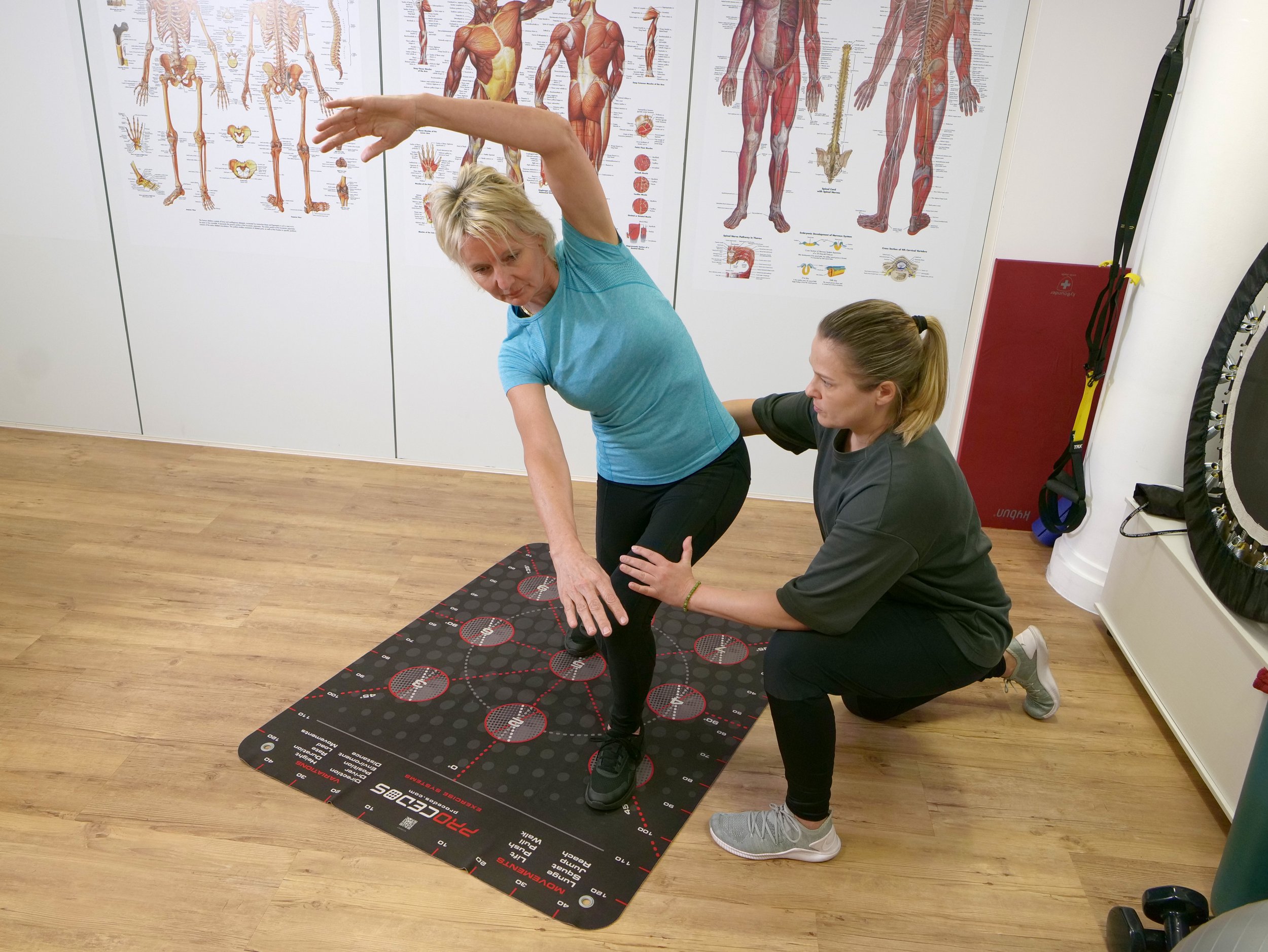
Every session is with Elizabeth. Every programme is built, adjusted, and progressed by her. You are not passed between practitioners, handed off to an associate, or slotted into a group class. The person who assesses you on day one is the person who coaches you on day two hundred.
That continuity matters more than most people realise. Your nervous system is a long-term relationship. The practitioner who knows your history, your tells, your compensations, and your patterns is the one best placed to guide you out of them. Consistency is a clinical tool.
02 ASSESSMENT
Assessment, through a neurological lens.
Every first session begins with a full neurological screen. Vision. Vestibular system. Proprioception. Reflexes. Movement quality in three planes. The body does not lie, but it does not volunteer information either. What we find in our initial consultation shapes everything that follows.
The Movement Bank™ is built on principles drawn from P-DTR, Z-Health, and Applied Movement Neurology, frameworks that read the nervous system's inputs rather than infer from its outputs. Every finding is material we can work with. That is where the plan begins.

03 APPROACH
Neurology first. Muscles follow.
For most of the clients I see, pain is no longer about active tissue damage. The acute injury has healed, the scan is clean, and yet the body is still producing the signal. In those cases, the nervous system is running a protection pattern, and the muscles are responding to it. Stretching the muscle when the signal has not changed is one reason the same patterns can keep returning.
The Movement Bank™ works at the level of that signal. We identify which inputs the nervous system is treating as threats, recalibrate them, and create the conditions for the body to do its own resolving. Change the inputs, change the outputs.
Often clients arrive having completed a course of physiotherapy alongside this work, or before it. The tissue work was right, and necessary; we simply pick up the thread at a different layer, working at the level of the nervous system rather than the tissue.

04 THE STUDIO
A space designed for the work.
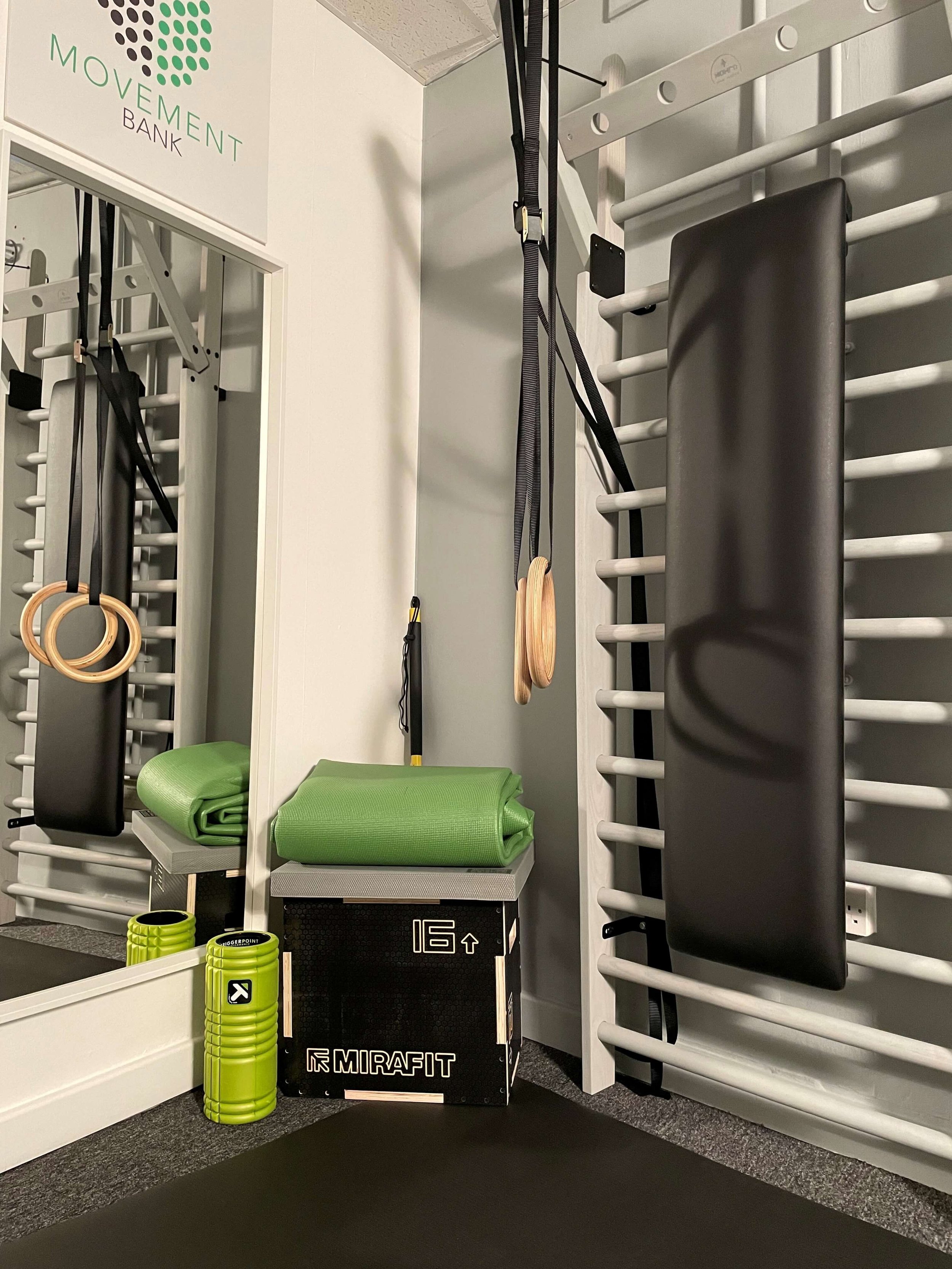
A private studio at Liverpool Street, chosen and arranged for one purpose. A calm, secure space where clients can settle in and the real work can happen. Not a gym. Not a clinic. Somewhere quieter, where the pace is set by the conversation and the assessment, not by the next appointment.
Equipment is here, organised around the work rather than the other way around. The familiar names are present, TRX, kettlebells, ropes. Alongside them, specialist tools you may not have seen elsewhere, used as the session calls for them.
The space matters. A nervous system asked to recalibrate needs the conditions to do so. Privacy. Calm. Time. The conditions matter as much as the technique.
05 THE TIME
By appointment. Never rushed.
Sessions are structured around the work that needs doing. The first consultation is ninety minutes. Follow-ups are 55 minutes. When the assessment reveals something that needs longer than that, we make the time.
Appointment-only private practice is a deliberate choice. Rushed work is the enemy of good work, especially with a nervous system that is already on alert.
— THE ROADMAP
How the work unfolds.
Every programme is different in pace and emphasis, but the broad shape is consistent.
Each phase prepares the ground for the next. Some clients move through quickly. For others, especially when the nervous system has been carrying load for a long time, the first phase is a key step that is often overlooked.
The pace is set by the system, not the calendar.
Stabilise
Settling the nervous system.
Build capacity
Adding load the system can now hold.
Recalibrate
Resetting the signal at source.
Integrate
Making the work belong to you.
— A NOTE BEFORE YOU BOOK
Different questions need different help.
If you have a fresh injury, an unexplained acute pain, or you are in the early stages after surgery, the right people for those questions are a GP, a consultant, or a physiotherapist. They diagnose, treat tissue, and manage acute rehabilitation. Those things sit outside what I do.
Movement coaching, as I practise it, works with a different question. When the tissue has healed, the diagnosis is established, and what remains is "why is this still here, and what do I do now," that is where my work lives. Often this runs alongside ongoing physiotherapy, not after it. Where a client already has a physiotherapist, I am glad to work in conjunction with them.
— WHO THIS IS FOR
This works for you if…
— You want the same coach, every session, long term
— You have tried physio or PT and want to go further into why
— You value private, calm, unhurried work
— You are curious about the neurology of your own body
— You want to understand why, not just what
— You are willing to do the home practice between sessions
— WHO THIS ISN’T FOR
This isn't for you if…
— You want a gym-style workout led by someone counting reps
— You want back cracks, deep tissue, or a sports massage
— You want a group class or small-group PT
— You want quick fixes without understanding what changed
— You want to see a different practitioner each week
— You are not open to doing anything between sessions
— NEXT STEP
If this is how you want to work.
The next step is a conversation. Tell us what you are working on and we will come back with honest thoughts on whether this is the right fit.